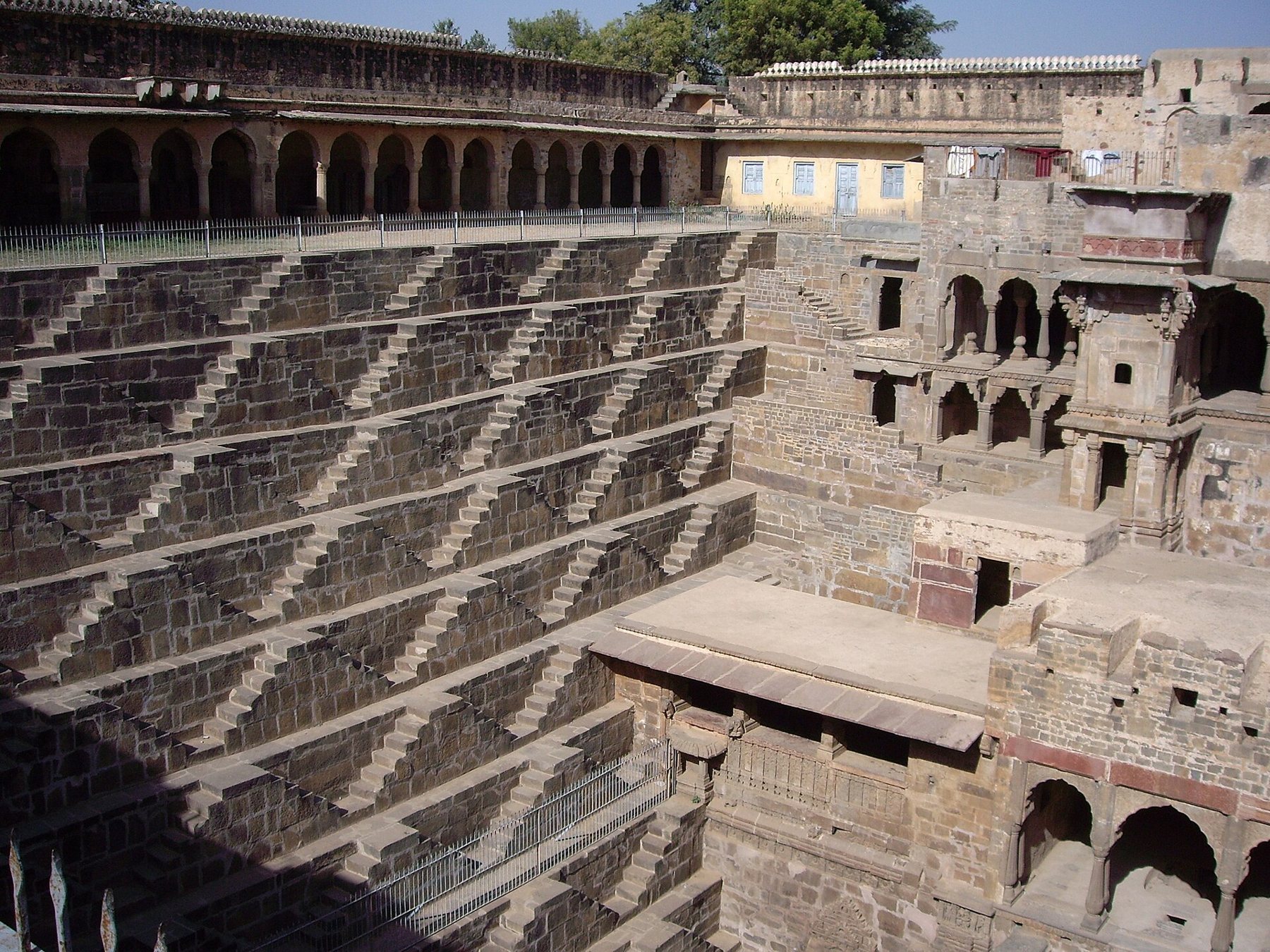
Chand Baori lies in the village of Abhaneri, in the Dausa district, about ninety kilometres east of Jaipur and a short detour from the main highway to Agra. It is one of the oldest and deepest stepwells in India, built around the 9th century by a local ruler remembered as Raja Chanda of the Nikumbha dynasty. From the top, its walls drop in thirteen storeys of steps to a small square of green water at the bottom, and the geometry of the steps, repeated over and over, makes it one of the most striking structures in the country.
A well like a building turned inside out
A stepwell reverses the logic of a normal building. Instead of rising from the ground, it sinks into it. Chand Baori is square, about thirty metres deep, and on three of its sides, flights of steps run down in a zigzag pattern, thousands of them in all, so that people could reach the water whatever its level. On the fourth side, a multi-storey pavilion with balconies, columns and niches stands against the wall, and once included rooms for the royal family. Much of this pavilion was added or rebuilt in the Mughal period, centuries after the well was first dug.
The steps are narrow and steep, and their repeated triangles create a pattern of light and shadow that changes through the day. Looking down from the edge, it is hard to judge the depth; the scale only becomes clear when you notice a person on the far side.
The well narrows as it goes down, and the steps are arranged in a double flight on each landing, so that the pattern seems to fold in on itself. Engineers and architects still admire how the structure has stood for more than a thousand years in a region of heavy monsoon rains, with the soil pressing in from all sides. The thick walls and the steps themselves act as buttresses, holding back the earth.
Why it was built
This is a dry region, where nearly all the year's rain falls in a few months. A deep well with steps allowed villagers to reach groundwater even at the end of the dry season, and the cool air at the bottom, several degrees lower than at the surface, made it a place of refuge from the heat. Stepwells were also places for bathing, rituals, gatherings and rest. Chand Baori, beside an important temple, was probably used for ritual washing before worship.
Rajasthan and neighbouring Gujarat once had thousands of stepwells. Many fell out of use in the 19th and 20th centuries, when piped water and tube wells replaced them, and were filled with rubbish or abandoned. In recent decades, interest in traditional water harvesting has grown again, and some have been cleaned and restored. Chand Baori, protected as a national monument, is the most famous survivor.
Local stories say the well was dug in a single night by spirits, a reminder of how astonishing such a structure must have seemed to people who used it. The village celebrates a festival at the temple each year, when the courtyard fills with worshippers.
The Harshat Mata temple
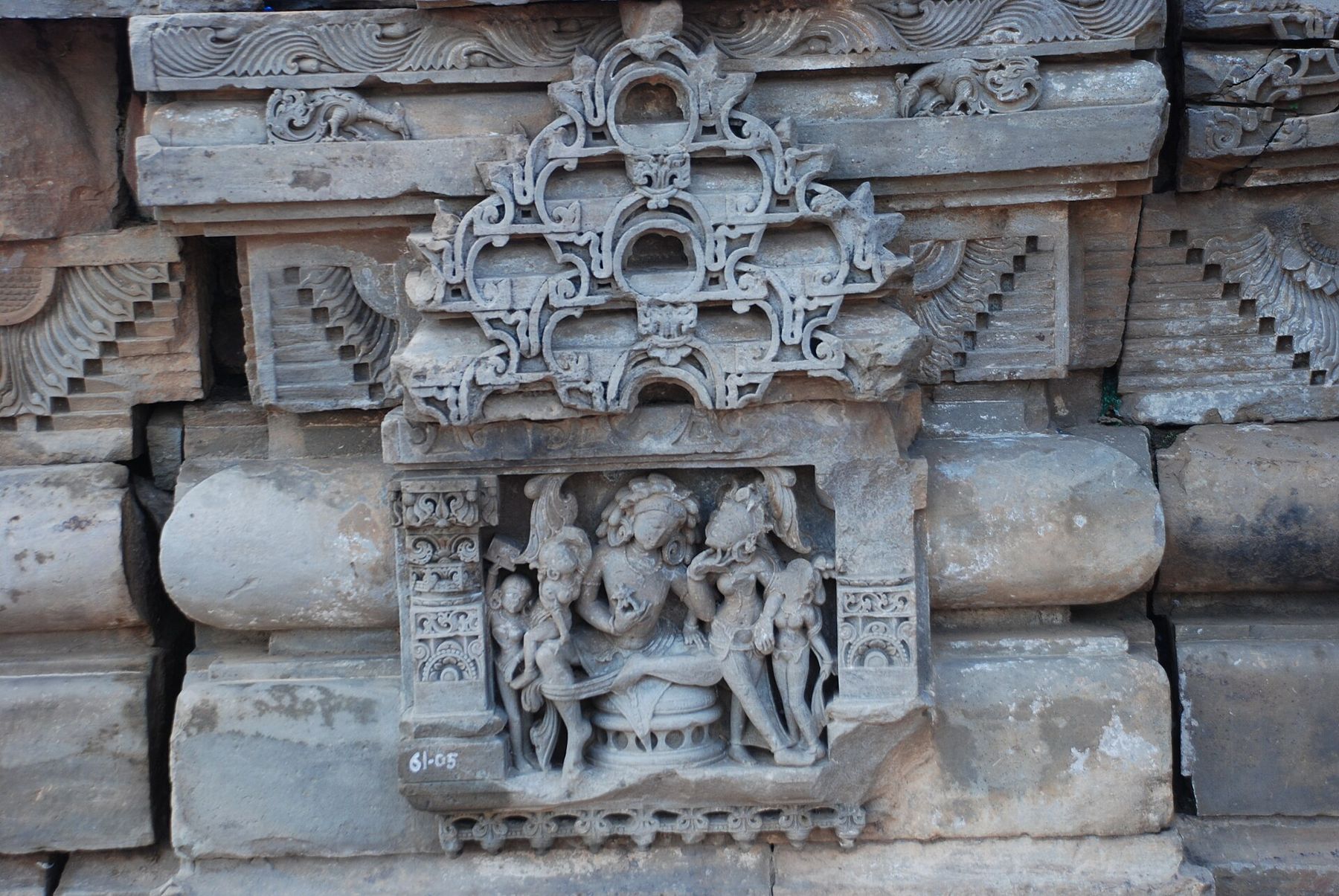
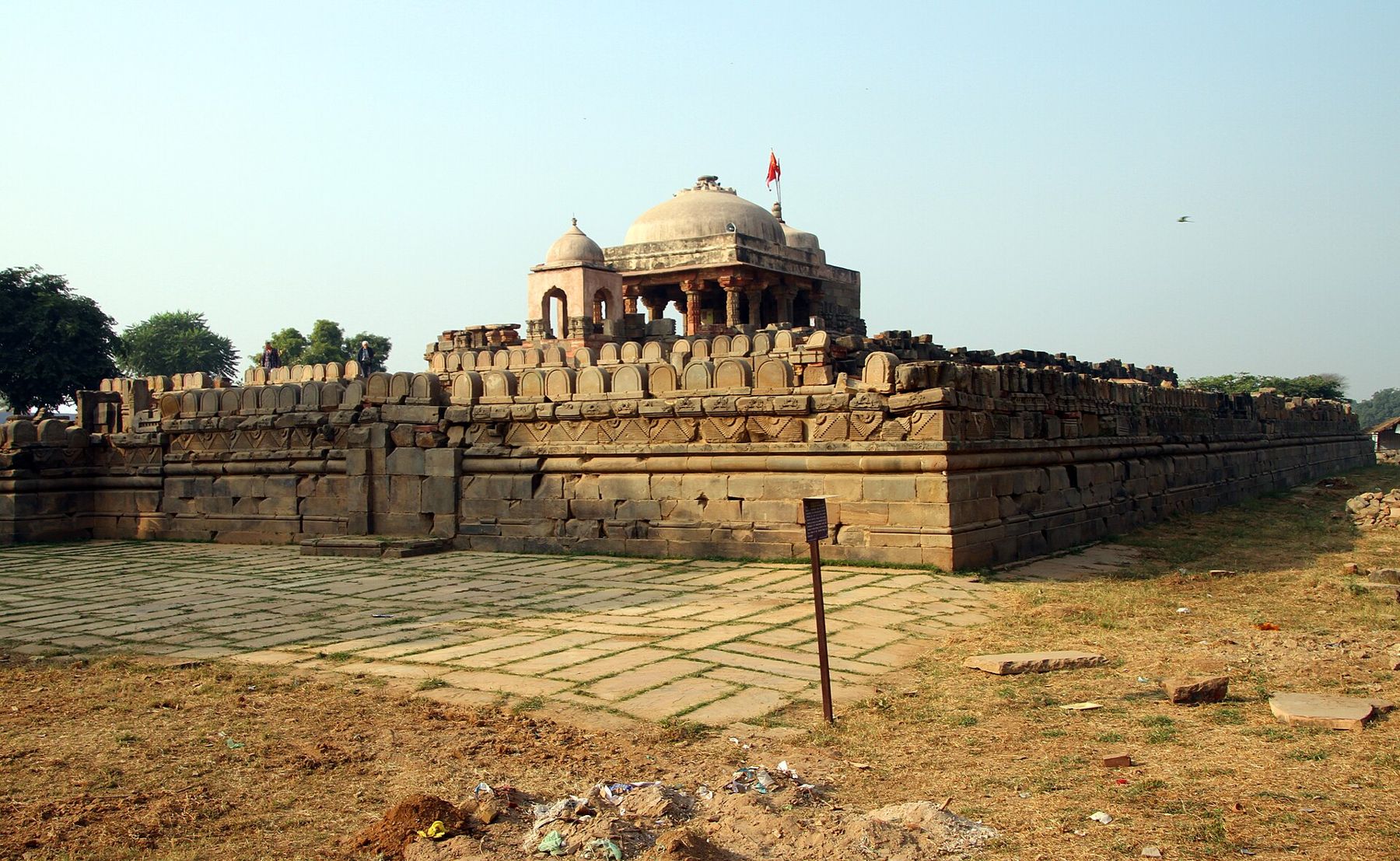
Next to the stepwell stand the remains of the Harshat Mata temple, dedicated to a goddess of joy, built around the same period, in the 8th or 9th century. It was badly damaged in later centuries, but its platform and carved fragments show it was once a fine temple, with sculptures of gods, dancers and musicians. Many of its carved panels are now displayed around the stepwell's courtyard, set into the walls and under the pavilions. Some pieces have found their way to museums.
The temple originally stood on a high platform, with a sanctum and a porch surrounded by smaller shrines, and its sculpture is among the finest of its period in this part of India. The figures that remain have soft, rounded forms and lively movement. Take time to look at them closely after the drama of the well.
Visitors are not allowed to walk down the steps; the well is protected, and the edges are fenced.
Another step · JaipurPanna Meena ka Kund: the stepwell behind Amber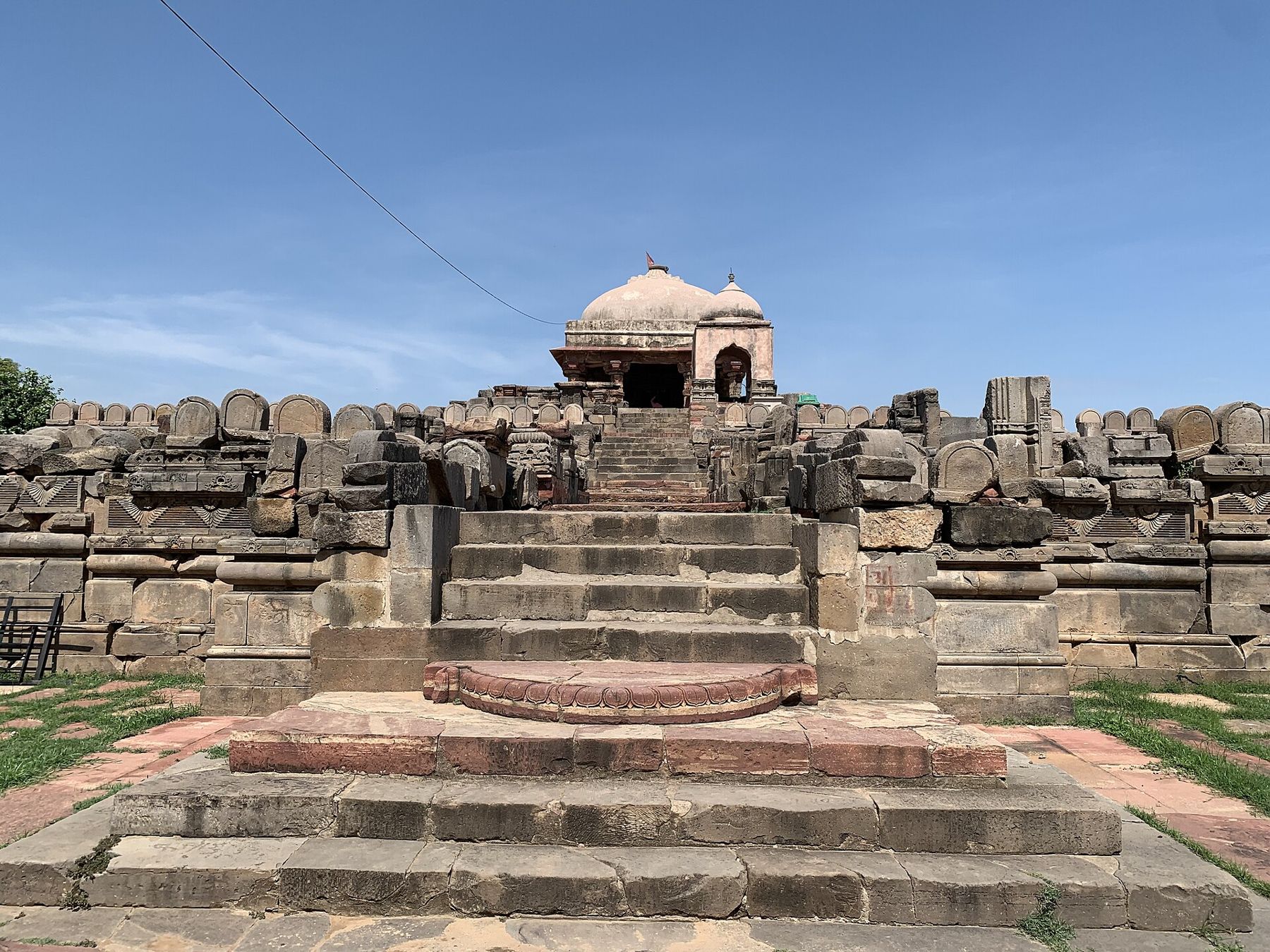
What you can and cannot do
Visitors are not allowed to walk down the steps; the well is protected, and the edges are fenced. You walk around the top on a paved gallery and look down from all four sides. The best views are from the corners and from the pavilion side, looking back across the steps. A small fee is usually charged, and the site is maintained by the Archaeological Survey of India. Opening hours and charges change, so check before you go.
The detour from the Agra road
Abhaneri is reached by road. Coming from Jaipur toward Agra on the main highway, turn off near Sikandra, and follow the small road north through farmland to the village. From Jaipur, allow about two hours each way; from Agra, around three. There is no convenient public transport, so most people visit by taxi or private car, often as a stop between Jaipur and Agra or on the way to Bharatpur. The nearest railway station is at Bandikui, some distance away.
The village itself is small and agricultural, with a few stalls by the stepwell and fields of yellow mustard and green wheat around it in the winter months. Local children may offer to guide you; a polite no is fine.
Many travellers combine Abhaneri with a journey between Jaipur and Agra, or with a visit to the bird sanctuary of Keoladeo National Park at Bharatpur, further east. If you are travelling by train, it is possible to hire a car from Jaipur for the day, see the stepwell in the morning and be back in the city in the afternoon.
The best light
The stepwell faces north, and its steps catch the light differently through the day. Mid-morning, when the sun is high enough to light the far walls but low enough to cast shadows across the steps, is ideal. Late afternoon is also good, and quieter. In the middle of a hot day, the courtyard is shadeless except for the pavilion, and the glare off the pale stone is strong. After the monsoon, from August to October, water stands deeper at the bottom.
Chand Baori is the bottom of the well on this site's home page: the deepest place, the point all the other steps lead to. For smaller stepwells you can see in the cities, try Panna Meena ka Kund in Amer or the Bundi stepwells.
Lenses on this page
- Pablo Nicolás Taibi Cicare · CC BY 2.0
- Chainwit · CC BY-SA 4.0
- Ajay Parikh 103 · CC BY-SA 3.0
- Gerd Eichmann · CC BY-SA 4.0
All photographers, all pages: whose lenses.