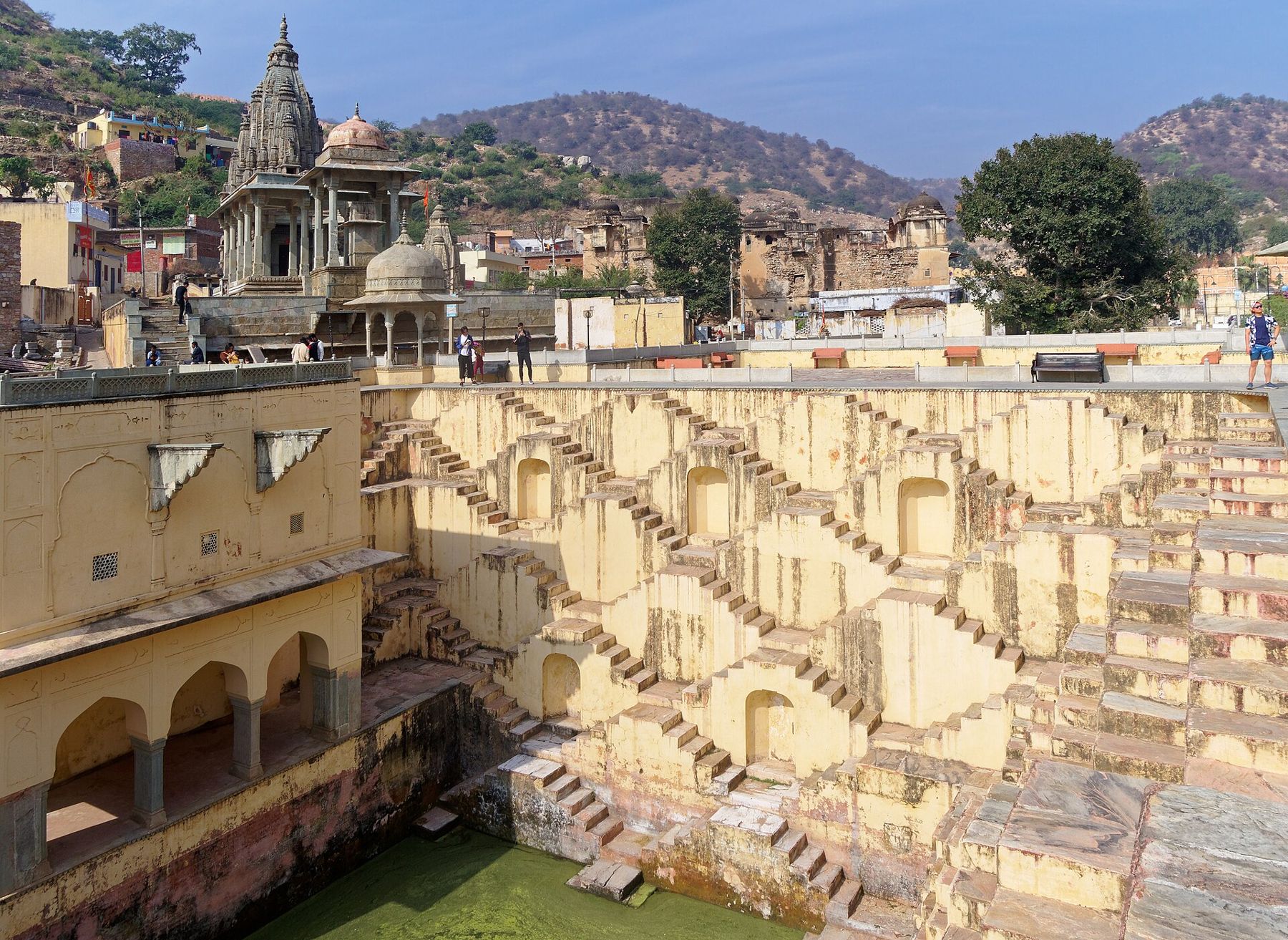
Below the fort of Amber, the old town of Amer is a tangle of lanes, temples and havelis that most visitors drive straight past. Walk into it from the fort, and in a few minutes you reach Panna Meena ka Kund, a stepwell built in the 16th century to collect rainwater for the town. It is square, about four storeys deep, and lined on three sides with flights of steps that crisscross down the walls to the water in a pattern of small triangles. On the fourth side, a covered gallery once gave shade to people who came to bathe and rest.
What a kund was for
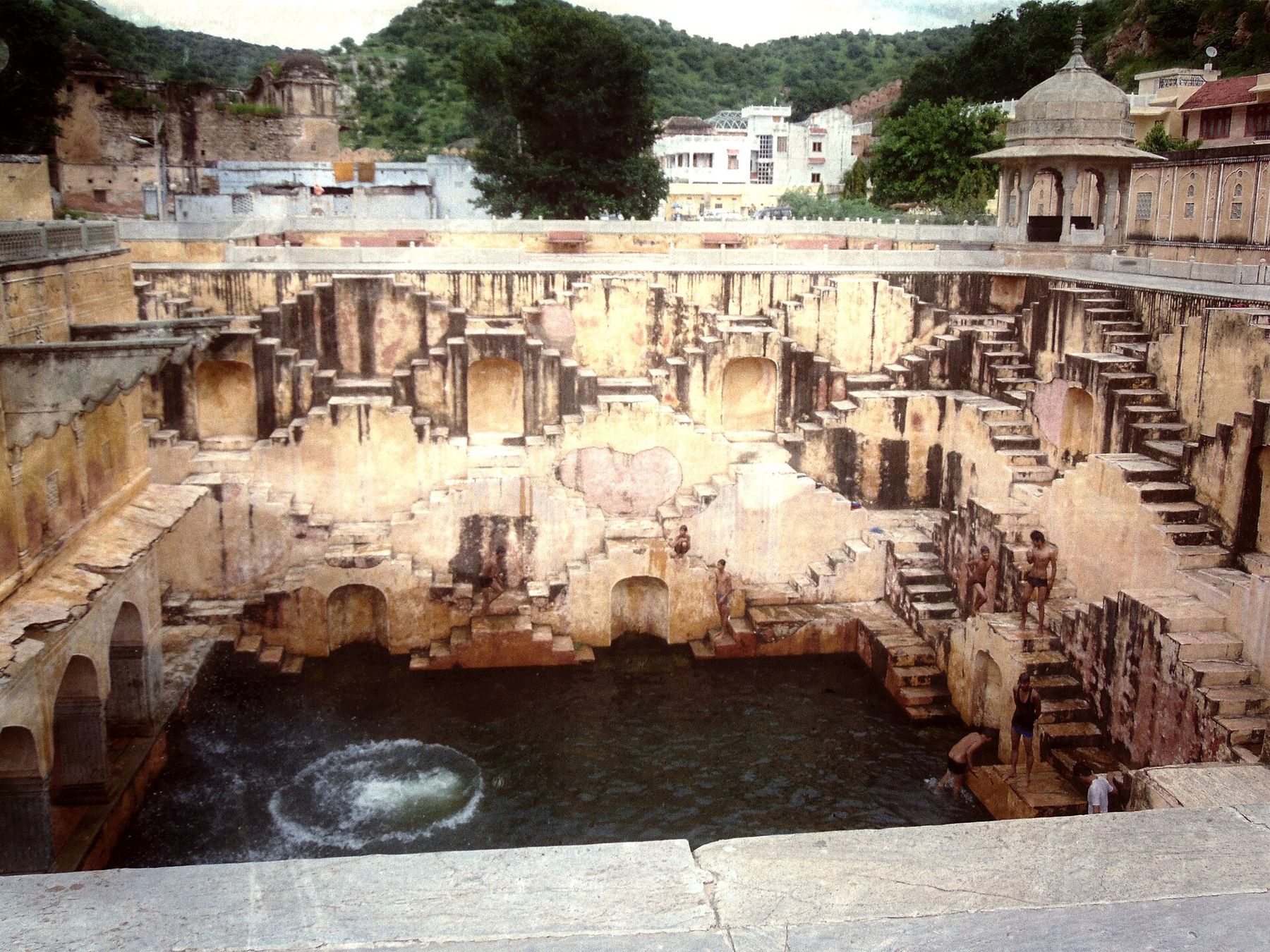
In a region where almost all rain falls in a few months of monsoon, storing water was a matter of survival. Stepwells and step tanks, called baori, vav, kund or jhalra in different places, were dug into the ground to collect rain and reach groundwater. Steps allowed people to walk down to the water at whatever level it stood, from brim-full after the monsoon to a small pool in the dry season.
They were also social places: cool in the heat, shaded, and used for bathing, washing, rituals and conversation. Many were paid for by rulers, queens or merchants as acts of public charity and piety, and decorated accordingly. Panna Meena ka Kund was more practical than grand, but its geometry has made it famous.
Its name is usually explained as coming from a local figure or community, but stories differ, and no one is certain who paid for it. The pattern of steps is not unique to this kund, but here it is unusually crisp and complete, and the small scale lets you take in the whole design at a glance.
The steps and the rules
The crisscross pattern of the steps is what everyone comes to see. From the top, the flights look like a zigzag embroidery in yellow stone, and as the sun moves, their shadows change the pattern. It is best seen from the edges at the top, and from the shaded gallery on the far side.
For safety and to protect the structure, walking down the steps has often been forbidden, and guards may stop you. Where it is allowed, take great care: the steps are narrow and steep, with no railings, and the stone can be slippery near the water. Respect whatever rules are in force on the day, and do not try to climb barriers for a photograph.
The kund is popular with photographers and with couples having wedding portraits taken, and on winter mornings you may find small crowds around the edges. Waiting a few minutes usually gives you a clear view. Keep away from the crumbling edges on the unfenced sides, and keep children close.
Amer village
The lanes around the kund belong to old Amer, the town that served the fort when it was the capital. Look for the Jagat Shiromani temple, a 17th-century temple with fine carving, and small shrines tucked between houses. The village is lived in, with children, cows and motorbikes in the lanes, and it is a pleasant contrast to the grandeur of the palace above. Be respectful when taking photographs of people and homes.
Amer has many more old buildings than most visitors realise, from small mosques to the ruined walls of mansions that once belonged to nobles of the court. The old town was the heart of the kingdom for centuries before Jaipur existed, and walking its lanes gives a sense of what a Rajput capital looked like at street level, below the palace walls.
Combining it with the fort
The kund is a ten-minute walk from the fort's lower entrance, or a short ride by auto-rickshaw. The easiest plan is to visit Amber Fort first, early in the morning, then walk down through the village to the kund, and end with a look at the temples. If you come by taxi, ask the driver to wait near the village rather than at the fort's busy car park.
A small handicrafts museum nearby, in a restored haveli, shows traditional block printing, and the lanes have workshops where you can see it done. Small charges may apply at some places; the kund itself has usually been free to visit, but that can change.
From Jaipur, Amer is reached by city bus or by taxi along the road that passes the lake palace of Jal Mahal, a palace standing in a shallow lake that is best seen from the roadside promenade. Combine all three for a morning, and return to the city for the afternoon in the walled city of Jaipur.
Seasons for the water
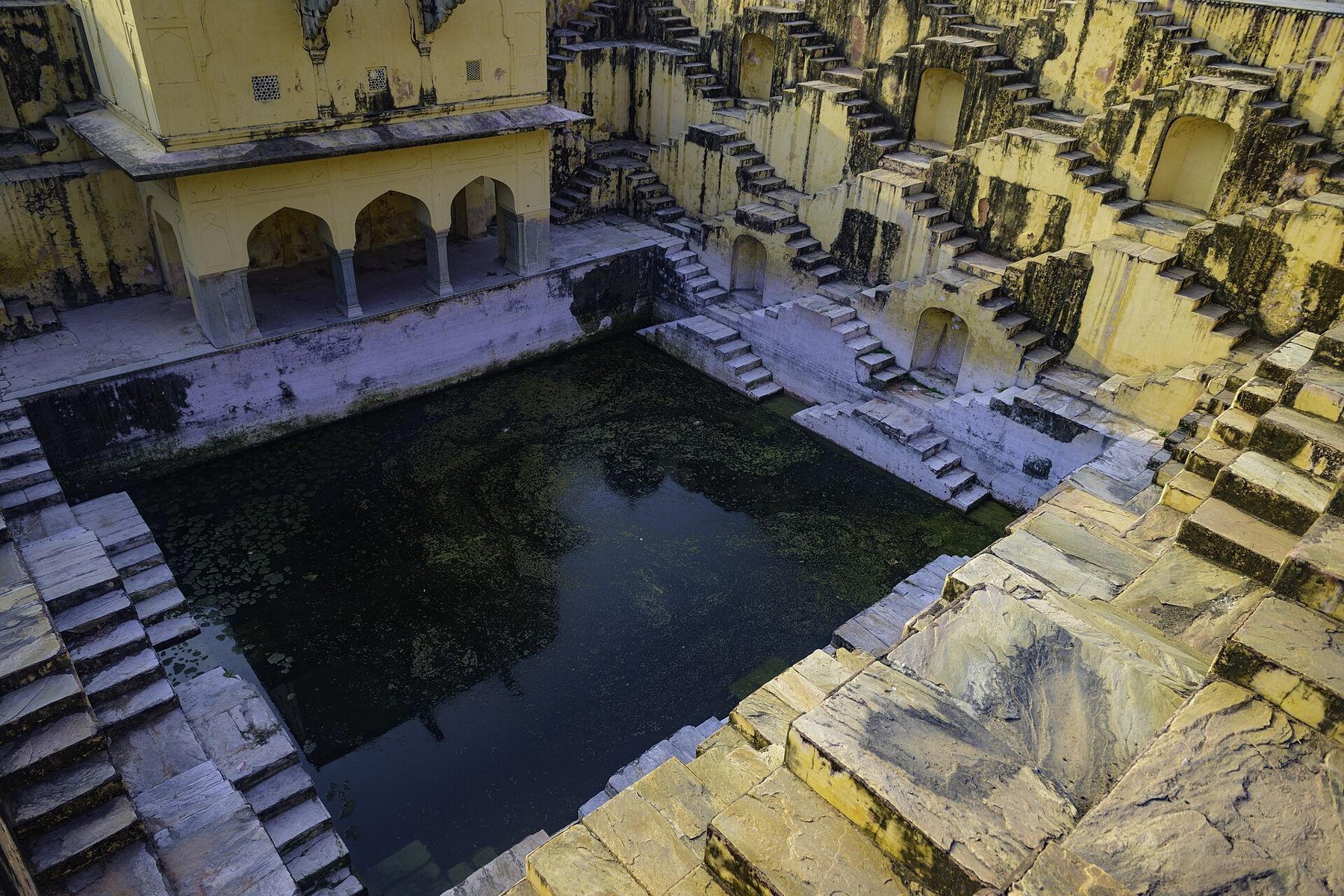
After the monsoon, from August to October, the kund may be partly full, and the water reflects the steps. By late spring, it can be nearly dry, which shows the full depth of the steps but loses the reflection. Both have their appeal. In the hot months, come early or late; the stone holds heat and there is little shade apart from the gallery.
A note on other stepwells
If Panna Meena ka Kund catches your interest, Rajasthan has many more stepwells, from the vast Chand Baori at Abhaneri, a couple of hours east of Jaipur, to the carved baoris of Bundi and the restored jhalra in Jodhpur. Each shows a different solution to the same problem: how to hold onto the monsoon for a whole year.
Lenses on this page
- Jakub Hałun · CC BY-SA 4.0
- Bobinson · CC BY-SA 4.0
- Gsuruchi06 · CC BY-SA 4.0
All photographers, all pages: whose lenses.